Programs
The Querrey InQbation Lab offers a variety of programs related to different phases of the commercialization process.
Our programs are open to Northwestern startups, faculty, undergraduate and graduate students, and postdoctoral fellows.
The InQbation Lab is Northwestern's hub for resources and space to translate Northwestern’s excellence in research-driven innovation out to the public. A home for early-stage, science-driven startups and the nucleus for a wide range of enabling programming for our university's faculty, researchers, and students, the InQbation Lab accelerates impactful technologies to society.
The Querrey InQbation Lab was named in honor of Kimberly K. Querrey (’22, ’23 P), chair of the Innovation and Entrepreneurship Committee of Northwestern’s Board of Trustees.
Q is for inQbation – where ideas, companies, people and products are incubated and accelerated. The Querrey InQbation Lab is where Questions become solutions.
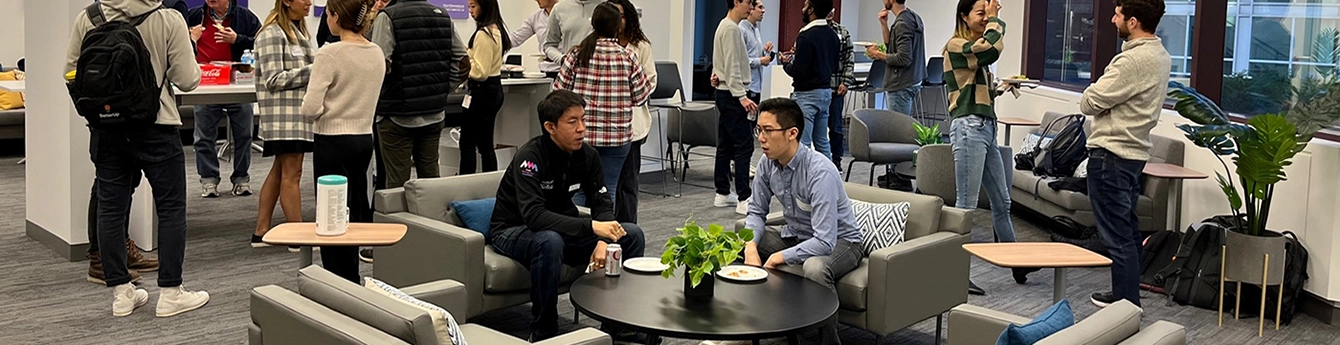
We provide space and community to bring together like-minded talent.
Through proximity and collaboration, our programs create a place for the best ideas and entrepreneurial knowledge to converge and for our network of funding and resources to expand.

The Querrey InQbation Lab offers a variety of programs related to different phases of the commercialization process.
Our programs are open to Northwestern startups, faculty, undergraduate and graduate students, and postdoctoral fellows.

The InQbation Lab offers private offices for resident startups, private and shared labs, foundries, conference rooms, classrooms and collaborative workspaces.

Northwestern's entrepreneurial faculty and resident startups can take advantage of resources including mentorship, legal assistance, funding, work spaces, libraries, and more.
Lisa Dhar, Northwestern's Associate Vice President for Innovation, explains the mission and purpose of the Querrey InQbation Lab.
The future of plastic recycling may soon get much less complicated, frustrating and tedious. In a new study, Northwestern University chemists have introduced a new plastic upcycling process that can drastically reduce — or perhaps even fully bypass — the laborious chore of pre-sorting mixed plastic waste.
Northwestern University engineers have developed a soft artificial muscle, paving the way for untethered animal- and human-scale robots. The new muscles, or actuators, provide the performance and mechanical properties required for building robotic musculoskeletal systems.
There are no upcoming events at this time.